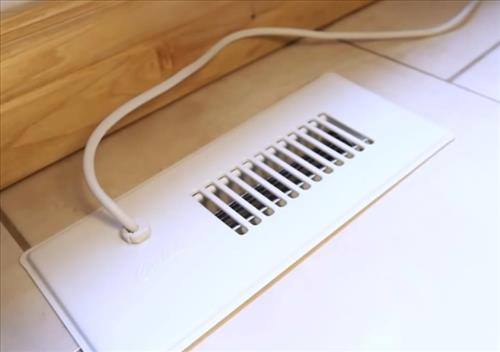
If you have a vent that is not outputting good airflow, there are several options to get it working properly.
Some air conditioning systems don’t push enough air out the vents creating a system that underperforms.
If this is happening to your system, then there are low-cost ways to boost the airflow.
How Do I Increase the Airflow in my Vents?
Airflow from vents can be improved with a bigger HVAC unit fan, installing large ducts, or booster fans.
The duct work should be examined for any problems, such as a collapsed duct.
Keep in mind, a dirty air filter or a closed damper can also cause weak airflow, so those should be checked first.
Airflow is blowing into the duct from the HVAC unit, which uses a blower motor to move the air.
If the blower motor is failing or is not big enough for the system, the ducts may not get good airflow.
Sometimes a duct may be too small and not big enough to carry enough air to a room.
Each part of the HVAC ductwork system can be examined and fixed.
Another popular option is to use booster fans that can also be installed, which increases airflow.
What are Vent Booster Fans?
Booster fans help to increase the airflow that comes out of a vent.
If you have a vent that has very low airflow pressure, a booster fan can help to increase it.
3 Ways to Boost Airflow in Vents
- Speed Up Blower Motor
- Install Larger Ducts
- Booster Fans
The airflow through the duct-work is created by the blower motor within the A/C unit.
Many blower motors have different speeds they can run at depending on how they are wired.
The installers may have known that the system was underperforming and already set the blower motor to run at max capacity, but it may be worth looking to see if it is.
Keep in mind, most A/C systems are set up for about 350 to 400 CFM per ton, so the blower should not be set faster than the system calls for.
The duct going to a room may be undersized and need a new larger one run.
For example, if a 6-inch duct is going to a vent, a 10-inch duct may add more airflow.
A new duct will need to be cut into the supply plenum or trunk line and to the vent.
Booster fans work by fitting an extra fan into the system giving it an extra boost.
There are different styles, from register grill-type fans to a fan that is put in the ductwork to pull more air.
There are several different types with our favorite options below.
As always be sure to read reviews on Amazon, here, or elsewhere to be sure a unit is the right pick for you.
*This post contains affiliate links.
Types of Register Vent Air Boosters
- Suncourt Flush Fit Register Air Booster Fan
- Heating Air Conditioning Booster
- Tjernlund RB10 Register Booster Fan
- VenTech DF6 Duct Fan
This type of booster is made to fit into the register and use a built in fan to increase the airflow. Air is pulled from the A/C unit for cooling or heating.
The right-sized dimension would be needed to fit, or one would have to be retrofitted into place.
This is a good simple option that uses a standard 4″ x 10″ register vent size.
Be sure to measure your vents before buying a booster fan to be sure it will fit.
Keep in mind, newer versions like the Suncourt HC500 have a built-in temperature sensor and turn on by themselves when the heating or A/C is running.
Also, most register booster fans are made for floor or wall registers and are not meant for ceiling vents.
This type of vent air booster simply sits on top of a register and has a powerful fan that pulls air out of the register and pushes it into the room.
As long as the register is on the floor it is the easiest to set up and is a quick, easy fix. It may not be a long-term solution, though, since it is not fitted into place.
This type can be used at the register or since its small size fitted to a vent in a room that needs a boost.
For example, this one has the dimensions of 4 X 10, so any vent with this dimension could have this placed in to get more airflow.
This air booster is fitted into existing ductwork which can dramatically boost the airflow.
It will require cutting the duct in the attic or where accessible and fitting it in the system.
This is most likely the best option but does require more work. If you are not a handy person, another option may be better.
Be sure to set up the duct fan to run only when the HVAC blower is running, which is usually done with a relay, a timer, or a pressure or temperature switch.
Summary
Any booster that is used will also need a power source which depending on the home layout, may or may not be a problem.
Be sure to plug a booster fan straight into a wall outlet instead of running an extension cord under a rug.
Keep in mind, a booster fan pulls air that would have gone to other rooms, so other vents may get a little less airflow.
A home that has an underperforming airflow most likely needs the ductwork looked at and possibly redesigned and replaced.
Of course, replacing home ductwork is an expensive undertaking.
Hopefully, one of the options above will work for your A/C unit and give the airflow needed without having to spend the time and money on new ductwork.